Finer Grinding Improves Feed Efficiency but Costs Mill Capacity
The particle-size target changes nutrient use, grinding demand, throughput and animal risk at the same time.

Courtesy of BarnX
The nutrition setting that also controls mill capacity
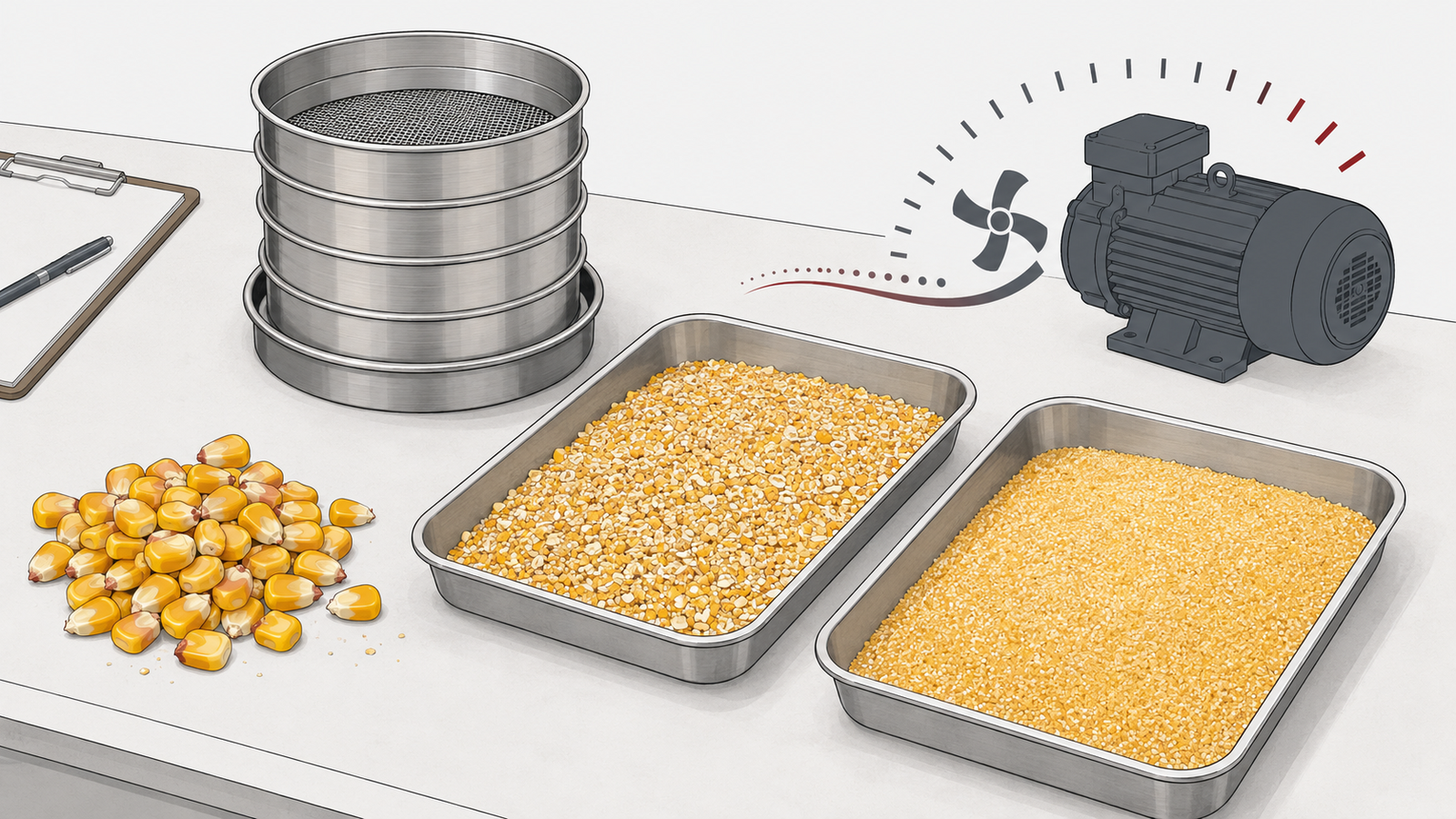
When feed efficiency needs improvement, grinding finer can look like an easy answer. Smaller grain particles expose more surface area to digestive enzymes, allowing an animal to extract more from each kilogram of feed. But the same change asks the grinder to do more work on every tonne. It can slow production, increase power use, create more dust, worsen flow and change animal-health risk.
Particle size is therefore not only a nutrition specification. It is a joint decision involving nutrition, production capacity, equipment condition, feed form and the customer’s animals.
What the controlled evidence shows
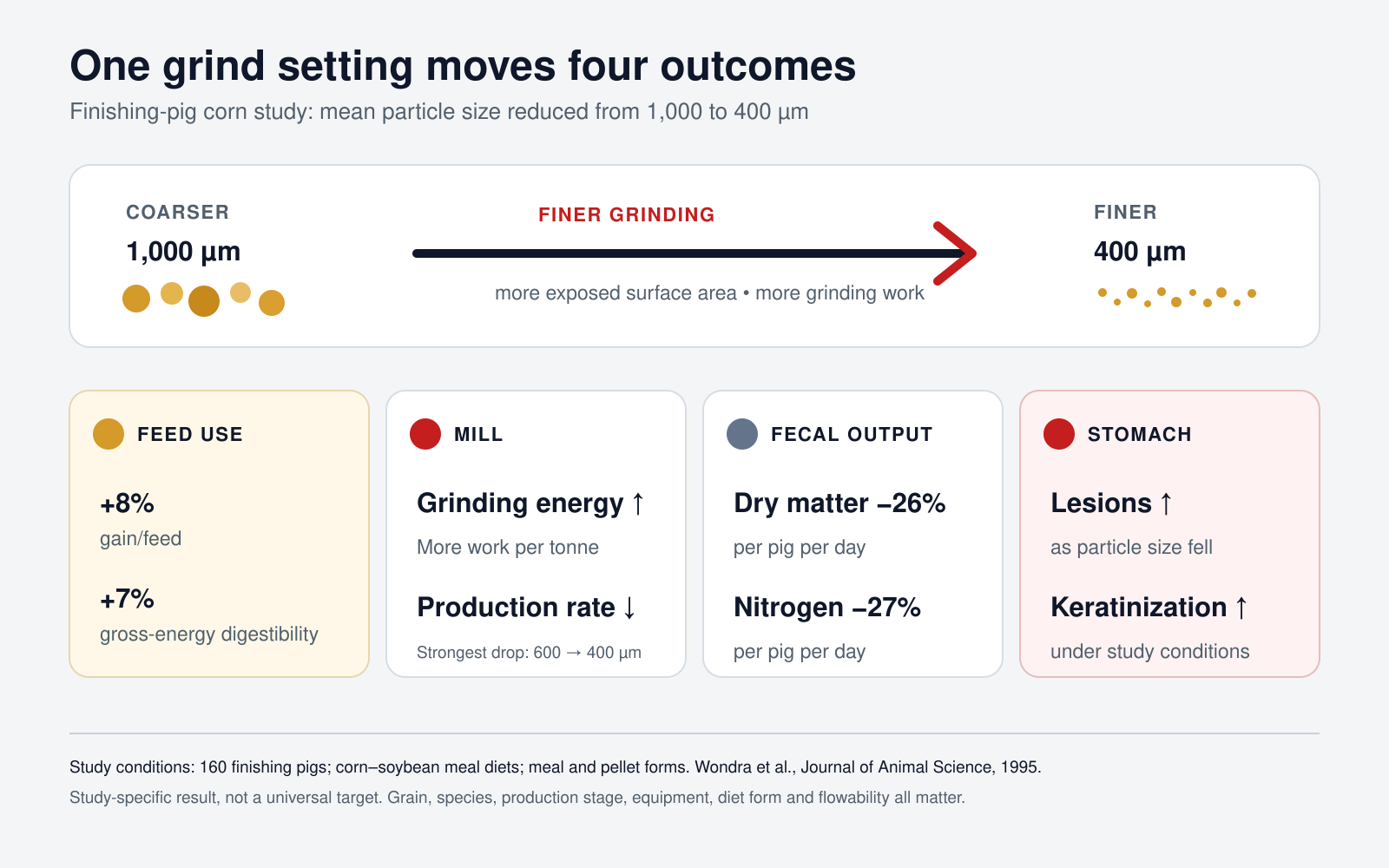
A peer-reviewed Kansas State study tested 160 finishing pigs on corn–soybean meal diets. Corn was ground to mean particle sizes of 1,000, 800, 600 or 400 µm, and the diets were fed in meal or pellet form.
Reducing corn from 1,000 to 400 µm improved gain per unit of feed by 8% and gross-energy digestibility by 7%. Because the pigs digested more and consumed less feed for the same gain, daily fecal dry-matter excretion fell by 26% and fecal nitrogen by 27%.
Those benefits did not come free. Electrical energy required for milling increased and production rate declined, with the authors noting a particularly strong penalty when particle size moved from 600 to 400 µm. Stomach lesions and keratinization also increased as particle size decreased. Considering animal performance, nutrient use, milling energy and stomach condition together, the authors described 600 µm or slightly less as an acceptable compromise under their study conditions.
Courtesy of BarnX
That conclusion is useful, but it is not a universal 600 µm rule. The work involved finishing pigs, corn-based diets and specific grinding equipment more than three decades ago. Grain type, pig stage, mill design, screen or roll settings, wear, diet form and farm handling can all shift the best economic point. USDA-NRCS guidance likewise treats finer grinding as a balance: it can improve digestibility, but further reduction raises energy cost, lowers throughput and can increase stomach-ulcer risk in pigs. Ruminants require a different physical structure, so the pig results must not be transferred to dairy or beef feeds.
The mean does not describe the whole grind
A second Kansas State study adds another practical warning. Researchers compared corn samples with approximately the same 850 µm mean but different particle-size uniformity. Pig growth was not significantly different, yet apparent nutrient digestibility improved as the distribution became more uniform.
This matters because a mill can hit the average while still producing too many coarse pieces and too many fines. Coarse particles may surrender digestible value; excessive fines can add dust, bridging and handling problems. A mean particle size without the distribution can hide both tails.
Turn the micron target into an operating control
Do not send production a single micron number and assume the job is finished. Build a control plan around it:
- Define the grain, species, production stage and diet form to which the target applies.
- Use representative samples and a consistent sieve method to track both the mean and the spread of particle sizes.
- Record tonnes per hour, kilowatt-hours per tonne, motor load, screen or roll settings and wear beside the laboratory result.
- Watch for dust, bridging, poor bin discharge and changes between the mill sample and feed presented to animals.
- Review the economics jointly: feed used per unit of gain, grinding cost, lost capacity and health or handling consequences.
The finest grind is not automatically the best grind. The best target is the point where animal value still exceeds the mill and handling cost.
Continue on the desk
Other briefs worth a read while you are here.
 Feed & LivestockCorn Silage Harvest Is a Chain of Decisions, Not a DateCorn silage quality cannot be repaired after the bunker is closed. As harvest approaches, farms should manage moisture, kernel processing, packing capacity, sealing and forage transition as one connected process.
 Logistics & DeliveryBroken Pellets Nearly Tripled. The Durability Test Barely Moved.A pellet durability index can remain high while the share of broken pellets in the load rises sharply. Mills need both mill-side PDI and downstream fines or breakage measurements to know what reaches the feeder.
 Grain & IngredientsA Two-Point Moisture Drop Costs More Than Two Percent of the WeightIf 100 tonnes of corn move from 15% to 13% moisture, the theoretical water shrink is 2.30 tonnes, not 2.00. Understanding that mass balance helps mills separate expected moisture loss from handling loss, measurement error and unexplained inventory variance.