Broken Pellets Nearly Tripled. The Durability Test Barely Moved.
Durability testing measures the pellets that survive screening, not all the breakage already created along the handling chain.
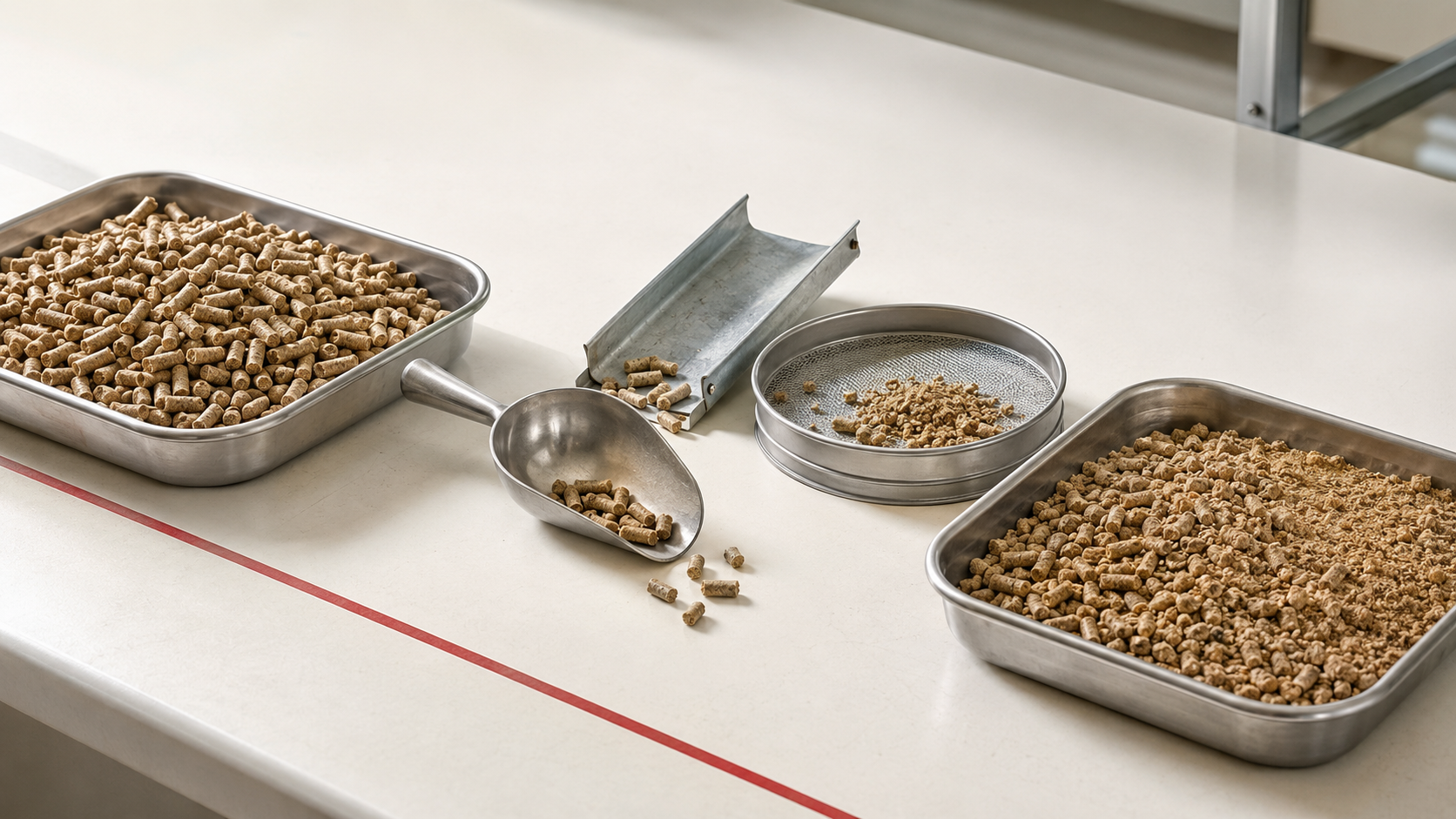

Courtesy of BarnX
A mill can report a pellet durability index above 92% and still deliver a load containing a large share of broken pellets. That sounds contradictory only if PDI is treated as a complete description of the load.
It is not. PDI answers a narrower question: how well do the pellets selected for the test resist a standardized mechanical challenge? The percentage of fines or broken pellets answers another question: how much of the material at a particular sampling point is no longer an intact pellet? Both measurements matter, but they are not interchangeable.
What PDI actually measures
In the standard tumble-box approach described by Kansas State University, fines are first sifted from a cooled pellet sample. A 500 g portion of the retained pellets is tumbled for 10 minutes, screened again, and the mass still retained is divided by the starting test mass. Holmen methods use a smaller screened sample and a controlled pneumatic challenge, but the central logic is similar: the test evaluates the pellets that entered the durability test.
This is useful. PDI helps a mill compare formulas, conditioning, dies, cooling and other process conditions. But material that broke before the sample was screened does not enter the PDI denominator. A strong PDI can therefore coexist with substantial breakage elsewhere in the handling chain.
The result that exposes the gap
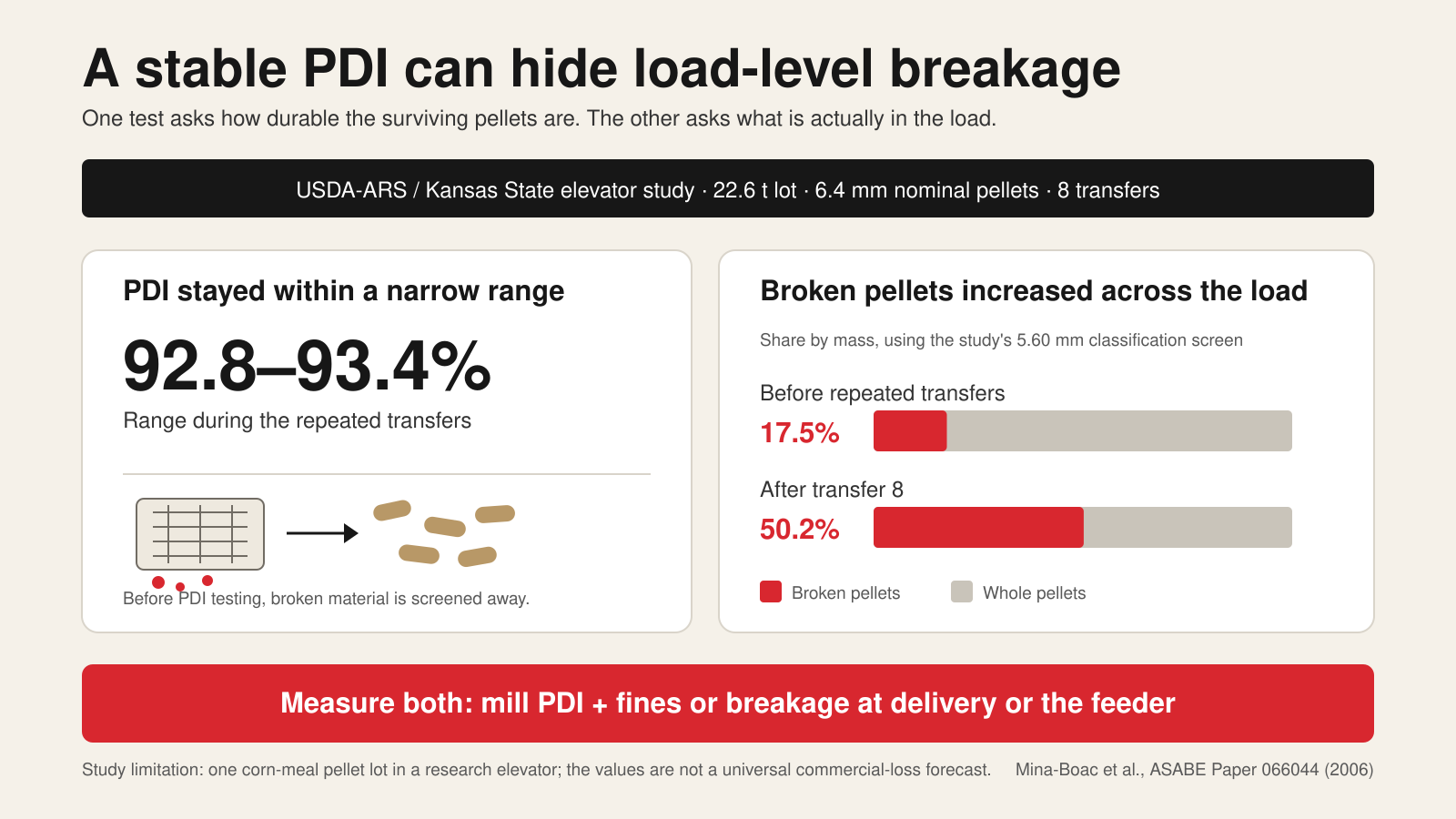
A 2006 USDA-ARS and Kansas State study followed one 22.6 t lot of corn-meal pellets through eight transfers in a research elevator. The pellets had a nominal diameter of 6.4 mm and moved at an average rate of 62.2 t/h. Researchers used a 5.60 mm screen to separate whole from broken pellets.
Before the repeated transfers, 17.5% of the pellet mass was classified as broken. After the eighth transfer, that share reached 50.2%. The apparent geometric mean diameter fell from 5.62 mm to 3.81 mm.
Yet PDI remained between 92.8% and 93.4% and did not change significantly during the transfers. The surviving, screen-retained pellets still performed well in the tumble test while the load accumulated substantially more broken material.
Courtesy of BarnX
That result should not be converted into a universal “four percentage points per transfer” rule. It involved one corn-meal pellet lot, deep research bins, a bucket elevator, spouts and a defined transfer path. Pellet formulation, diameter, moisture, temperature, drop height, conveying system and number of impacts all affect breakage. The study demonstrates the measurement gap, not the expected loss on every delivery route.
Why the load changes after the cooler
Handling applies three broad forces. Impact occurs when pellets strike equipment or a pile after a drop. Compression crushes pellets under load or at contact points. Shear abrades surfaces as pellets move against equipment and one another. Loadout, truck movement, unloading, farm augers and feed lines can add further events after the mill’s cooler sample was collected.
The operational consequence is real. Kansas State’s pelleting guide recommends using the combination of mill PDI and fines measured at the feeder to assess delivered pellet quality. In controlled grow-finish pig experiments, increasing fines within pelleted diets was associated with progressively poorer feed-to-gain, although the magnitude depended on pig weight and the experimental treatments. Those animal results are species- and study-specific, but they reinforce why “pelleted at the mill” is not the same as “intact at consumption.”
Build a paired measurement instead of relying on one mill result:
- Measure PDI on a consistent cooled-pellet sample at the mill.
- Measure fines or broken pellets with a defined screen at loadout and at a downstream point such as truck discharge, farm receiving or the feeder.
- Compare the same formula and lot whenever possible, and record the route, conveying equipment and sampling location.
- Investigate where the largest change appears before changing formulation or slowing the pellet mill.
Continue on the desk
Briefs from other lanes worth a read while you are here.
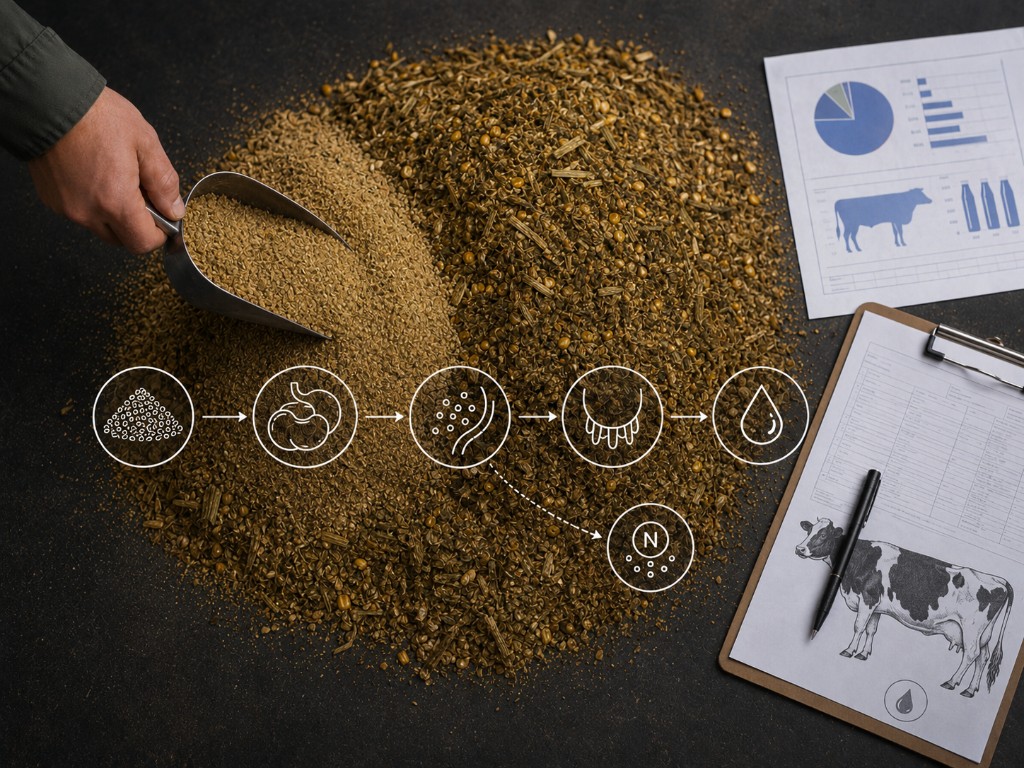 Feed & LivestockMore Crude Protein Is Not the Same as More Milk ProteinCrude protein describes how much nitrogen is in a ration, not how much balanced, digestible amino-acid supply reaches the mammary gland. Before increasing soybean meal, canola meal or another protein source, identify whether the real limitation is intake, rumen microbial protein, metabolizable protein, amino acids or energy.
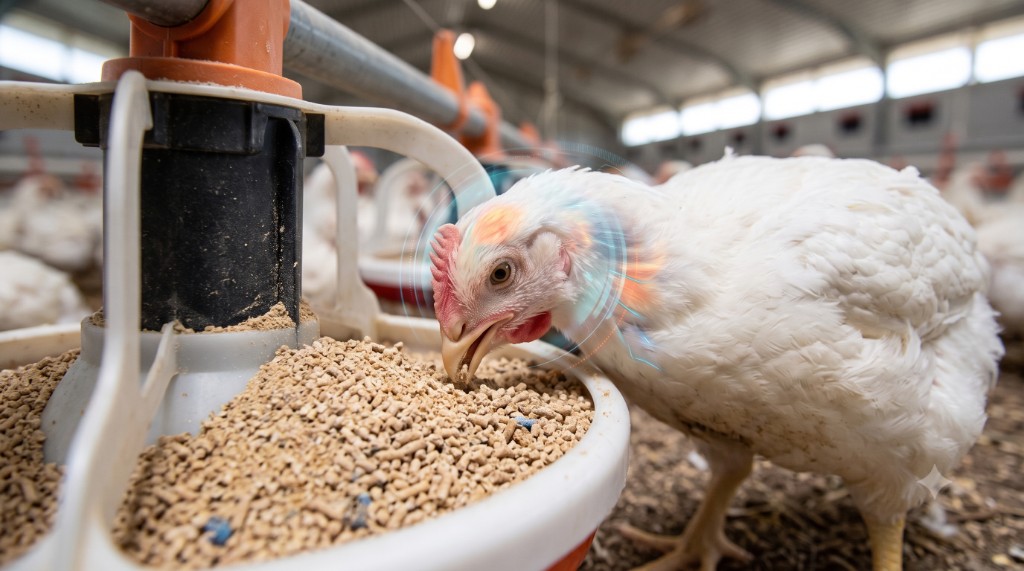 Feed & LivestockThe Hidden Caloric Cost of Pellet FinesFines are often treated as a handling nuisance. Effective Caloric Value research shows they can also drain up to 187 kcal/kg of apparent metabolizable energy through the physical effort of eating—changing FCR even when the formula on paper looks strong.
 Feed & LivestockFiner Grinding Improves Feed Efficiency but Costs Mill CapacityIn a controlled finishing-pig study, reducing corn particle size from 1,000 to 400 µm improved gain per unit of feed by 8%, but it also increased grinding energy, reduced production rate and increased stomach lesions. The right target is a documented mill-and-animal compromise, not simply the finest grind available.